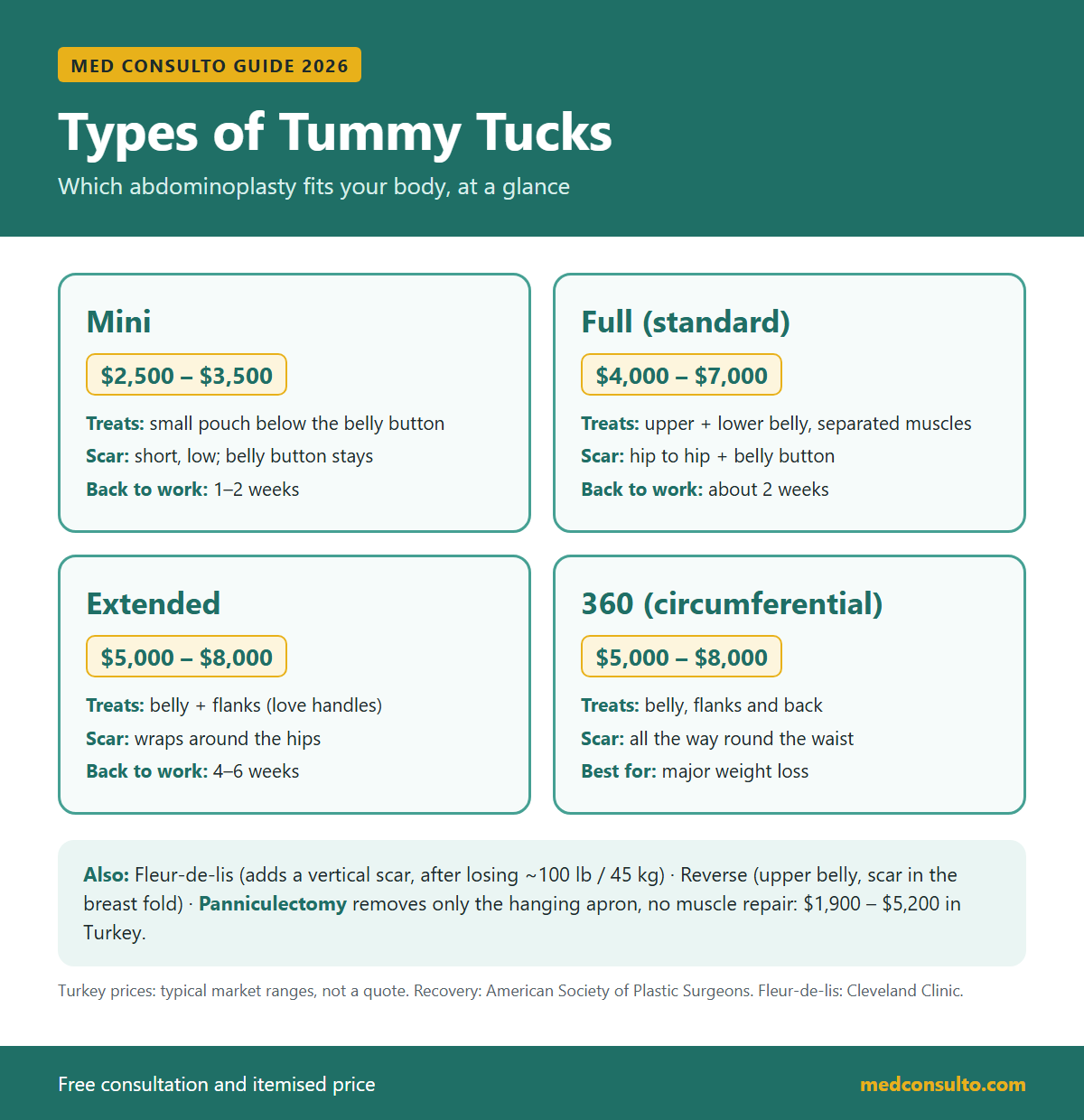
The main types of tummy tucks are the mini tummy tuck, the full (standard) tummy tuck, the extended tummy tuck and the 360 (circumferential) tummy tuck, with the fleur-de-lis and reverse tummy tuck for special cases. The right type depends on where your loose skin is (below the belly button only, the whole front of the belly, or the sides and back too) and whether your stomach muscles have separated. A mini tummy tuck has the shortest scar and recovery, while an extended or 360 tummy tuck treats the most skin but needs the longest healing. In Turkey a mini tummy tuck typically costs $2,500 to $3,500, a full tummy tuck $4,000 to $7,000 and an extended or 360 tummy tuck $5,000 to $8,000.
There are several types of tummy tucks, and choosing the wrong one can mean a bigger scar than you need or a result that leaves loose skin behind. This guide compares the different types of tummy tuck side by side: what each one treats, where the scar sits, how long recovery takes and what each costs in Turkey. It also explains tummy tuck with muscle repair, the male tummy tuck, and how a tummy tuck differs from a panniculectomy and from liposuction, so you can arrive at your consultation knowing which questions to ask.
What are the different types of tummy tucks?
The different types of tummy tucks are the mini (partial), full (standard), extended, 360 (circumferential), fleur-de-lis and reverse tummy tuck; they differ in incision length, how much skin is removed and whether the muscles and belly button are treated.
Every tummy tuck, or abdominoplasty, removes loose skin and some fat from the abdomen. What changes from one type to another is how far the incision runs and which part of the body is reshaped. The American Society of Plastic Surgeons (ASPS) describes three main types, mini, standard and extended, and says the choice depends on the amount and location of excess skin and fat.
Types of tummy tucks compared
| Type of tummy tuck | Incision and scar | Muscle repair | Belly button | Best for |
|---|---|---|---|---|
| Mini tummy tuck | Short, low scar above the pubic area | Lower belly only, if needed | Usually not moved | A small pouch of loose skin below the belly button |
| Full (standard) tummy tuck | Hip-to-hip scar plus a scar around the belly button | Yes, upper and lower belly | Repositioned | Loose skin above and below the belly button and separated muscles |
| Extended tummy tuck | Longer scar that wraps around the hips and flanks | Yes | Repositioned | Loose skin on the belly and the sides (love handles) |
| 360 (circumferential) tummy tuck | Scar all the way round the body | Yes | Repositioned | Loose skin on the belly, flanks and back after major weight loss |
| Fleur-de-lis tummy tuck | Horizontal scar plus a vertical midline scar (inverted T) | Yes | Repositioned | Loose skin in both directions after losing about 100 lb (45 kg) or more |
| Reverse tummy tuck | Scar in the breast fold | Sometimes | Usually not moved | Loose skin mainly in the upper belly |
Mini tummy tuck
A mini tummy tuck removes a small pouch of loose skin and fat below the belly button through a short, low incision, usually without moving the belly button, and has the quickest recovery of all the types of tummy tuck.
A mini tummy tuck, or partial abdominoplasty, suits people whose concern is limited to the lower belly, for example a small overhang after a caesarean section, while the skin above the belly button is still firm. The surgeon removes the excess lower skin and can tighten the lower part of the stomach muscles. According to ASPS, most people return to work one to two weeks after a mini tummy tuck and resume more vigorous activity in about five to six weeks. The trade-off is that the result is limited to the area below the belly button.
- Pros: shorter scar, shorter operation, faster recovery and lower cost.
- Cons: does not treat loose skin above the belly button or full muscle separation.
- Mini tummy tuck cost in Turkey: about $2,500 to $3,500.
Full (standard) tummy tuck
A full or standard tummy tuck is the most common type: the surgeon makes a hip-to-hip incision just above the pubic area, removes loose skin and fat from the upper and lower belly, repairs separated muscles and repositions the belly button.
ASPS describes the standard tummy tuck as the most common type of abdominoplasty and the best choice for men and women who want to firm the area both above and below the belly button, including people with diastasis recti (separated stomach muscles). Most patients return to non-strenuous work after a couple of weeks, but it takes around three months to recover fully. The scar sits low enough to be hidden by most underwear and swimwear.
- Pros: treats the whole front of the abdomen and repairs the muscle wall.
- Cons: longer scar than a mini, plus a scar around the belly button.
- Full tummy tuck cost in Turkey: about $4,000 to $7,000.
Tummy tuck with muscle repair
Muscle repair, also called plication, is the step that stitches the two vertical stomach muscles (the rectus abdominis) back together when pregnancy or weight changes have pulled them apart. It is usually part of a full tummy tuck, and it is the main reason many people still have a “pooch” after diet and exercise. Repaired muscles need time to heal, so lifting and hard core exercise are restricted for about six weeks or longer. Muscle repair tends to make the first days of recovery more uncomfortable than a skin-only operation. A tummy tuck without muscle repair is sometimes chosen when the muscles are intact and only skin needs removing. Always check that muscle repair is included in a quote, not charged as an extra.
Extended tummy tuck
An extended tummy tuck uses a longer incision that wraps around the hips to remove loose skin and fat from the abdomen and the flanks (love handles) as well as the front of the belly.
ASPS recommends an extended tummy tuck if you have a lot of excess, sagging skin on the abdomen and flanks. The surgeon repositions the belly button and often adds liposuction for stubborn fat in the upper and lower abdomen and flanks, a combination sometimes called lipoabdominoplasty. Recovery is longer: ASPS says you will typically need about four to six weeks of downtime before returning to work and about 12 more weeks before strenuous activity. If the main problem at your sides is fat rather than loose skin, love handle liposuction may be enough.
360 tummy tuck (circumferential abdominoplasty)
A 360 tummy tuck, or circumferential abdominoplasty, removes loose skin all the way around the body, from the belly, flanks and lower back, through an incision that circles the waist.
Cleveland Clinic describes the circumferential (extended) abdominoplasty as surgery that treats the front and the back, including the love handles and hips, and changes the shape of the body from all sides. It is mainly for people who have lost a large amount of weight, for example after bariatric surgery, and is sometimes combined with a buttock lift as a lower body lift. It is the longest of the operations described here, so surgeons are especially careful about blood clot prevention and fluid collections. In Turkey an extended or 360 tummy tuck typically costs $5,000 to $8,000.

Fleur-de-lis and reverse tummy tuck
A fleur-de-lis tummy tuck adds a vertical midline incision to the usual horizontal one to remove loose skin in both directions after major weight loss, while a reverse tummy tuck lifts loose skin of the upper belly through an incision in the breast fold.
Fleur-de-lis tummy tuck
Cleveland Clinic explains that the fleur-de-lis technique makes a T-shaped incision, up and down as well as side to side, and is reserved for people who have lost a large amount of weight, usually 100 pounds (45 kilograms) or more. It narrows the waist more than a horizontal incision alone, at the cost of an extra vertical scar.
Reverse tummy tuck
A reverse abdominoplasty is a less common option for people whose loose skin is mainly above the belly button while the lower belly is firm. The skin is pulled upwards and the scar is hidden in the fold under the breasts, which is why it is sometimes combined with breast surgery.
Male tummy tuck
A male tummy tuck is the same operation as in women, most often a full or extended tummy tuck, but it is usually planned to keep a straighter, more athletic waistline and is commonly combined with liposuction of the flanks.
Men usually seek a tummy tuck after major weight loss, and ASPS notes that the standard tummy tuck suits both men and women. Because men tend to store more fat inside the abdomen, around the organs, a tummy tuck cannot flatten a belly that is firm and rounded from internal fat; losing weight first is the answer in that case. Candidacy, recovery and risks are the same as for women. For fat without loose skin, stomach liposuction is often the better operation.
Which type of tummy tuck is best for you?
The best type of tummy tuck is the smallest operation that treats all of your loose skin: a mini for a lower-belly pouch only, a full tummy tuck for loose skin above and below the belly button with separated muscles, and an extended or 360 tummy tuck when loose skin reaches the sides or back.
- Where is the loose skin? Only below the belly button points to a mini; the whole front of the belly points to a full tummy tuck; the hips, flanks or back point to an extended or 360.
- Have your muscles separated? A bulge that stays when you are lean, often after pregnancy, usually means diastasis recti and a full tummy tuck with muscle repair.
- How much weight have you lost? Large weight loss often leaves skin that needs an extended, 360 or fleur-de-lis tummy tuck.
- Is it skin or fat? If your skin is firm and only fat bothers you, liposuction may be enough.
- Are you ready? ASPS advises being close to your ideal weight and having finished with future pregnancies, because a later pregnancy can stretch out the muscle repair.
ASPS stresses that the final choice is made after a thorough assessment of skin laxity, health, body type and previous scars by a qualified plastic surgeon. Previous abdominal scars, such as from a caesarean section or gallbladder surgery, can change which technique is safest.

Cost of each type of tummy tuck in Turkey
In Turkey a mini tummy tuck typically costs $2,500 to $3,500, a full tummy tuck $4,000 to $7,000 and an extended or 360 tummy tuck $5,000 to $8,000, while a panniculectomy costs about $1,900 to $5,200.
| Procedure | Typical cost in Turkey | Recovery before desk work* |
|---|---|---|
| Mini tummy tuck | $2,500–$3,500 | 1–2 weeks |
| Full (standard) tummy tuck | $4,000–$7,000 | About 2 weeks |
| Extended or 360 tummy tuck | $5,000–$8,000 | 4–6 weeks |
| Panniculectomy | $1,900–$5,200 | About 2 weeks |
Typical market ranges, not a quote. *Recovery figures from ASPS. Fleur-de-lis and reverse tummy tucks are priced individually after a surgeon reviews your photos. Medconsulto gives you an itemised written price before you travel.
The American Society of Plastic Surgeons reports an average tummy tuck surgeon’s fee of $8,174 in the United States, before anaesthesia and hospital costs. For what a Turkish package should include, how long to stay and how to check a hospital, see our full guide to tummy tuck in Turkey.
Panniculectomy vs tummy tuck: what is the difference?
A panniculectomy removes only the hanging apron of skin and fat (the pannus) below the belly button for medical and comfort reasons, while a tummy tuck also tightens the stomach muscles, reshapes the upper belly and creates a new belly button for a cosmetic result.
In an ASPS interview, a member surgeon explains that both operations use a horizontal incision low on the abdomen and remove skin below the belly button, but a panniculectomy does not touch the muscles and does not involve shaping a new belly button. Panniculectomy patients are often people who have lost a lot of weight and have rashes, infections, hygiene or mobility problems caused by the overhanging skin.
| Panniculectomy | Tummy tuck | |
|---|---|---|
| Main goal | Medical and functional relief | Cosmetic reshaping |
| Removes hanging skin and fat | Yes, below the belly button | Yes, above and below the belly button |
| Muscle repair | No | Usually yes |
| Belly button | Not reshaped | Repositioned |
| Insurance (at home) | Sometimes covered when medically necessary | Rarely covered |
| Cost in Turkey | $1,900–$5,200 | $2,500–$8,000 depending on type |
Can you combine a panniculectomy and a tummy tuck?
Yes. A surgeon can remove the pannus and, in the same operation, repair the muscles and reshape the upper belly, which effectively turns the panniculectomy into a full tummy tuck. Recovery is similar: in the ASPS interview, both operations needed about two weeks of recovery with lifting restrictions for about six weeks, and muscle repair made the early days more uncomfortable.
Liposuction vs tummy tuck: which is better for belly fat?
Liposuction is better for stubborn belly fat when your skin is firm, while a tummy tuck is better when you have loose, overhanging skin or separated muscles, because liposuction cannot remove skin or repair muscles.
| Liposuction | Tummy tuck | |
|---|---|---|
| Removes fat | Yes | Yes, from the lower belly |
| Removes loose skin | No | Yes |
| Repairs muscles | No | Yes (full tummy tuck) |
| Scar | A few tiny scars | Long, low scar |
| Recovery | Usually shorter | Longer |
The two are often combined: liposuction shapes the waist and flanks while the tummy tuck removes the skin. To compare fat-removal techniques, read our guide to the types of liposuction or to liposuction in Turkey. Non-surgical fat reduction such as CoolSculpting treats small fat bulges but cannot tighten loose skin.
Risks and recovery for every type of tummy tuck
All types of tummy tuck share the same main risks, seroma, bleeding, infection, wound-healing problems, blood clots, numbness and visible scarring, and the risk and recovery time rise with the size of the operation.
- Seroma (fluid under the skin) is the most common local complication, seen after about 10.9 percent of abdominoplasties in a 2021 meta-analysis of 27,834 patients.
- Wound-healing problems are more likely in smokers and in longer incisions.
- Blood clots are a concern after long operations and long flights, so walking early and following your surgeon’s clot-prevention plan matter.
- Scars are permanent; they fade over 12 months or more but do not disappear.
For a week-by-week timeline, scar care and belly button healing, read tummy tuck recovery: what to expect.
Why plan your tummy tuck with Medconsulto?
Medconsulto helps you find out which type of tummy tuck you actually need before you travel, and plans the surgery, hospital stay and aftercare in Turkey with a qualified medical team.
- The right operation, not the biggest one: if a mini tummy tuck or liposuction would suit you better, we tell you before you spend anything.
- Specialist plastic surgeons and hospitals licensed by the Turkish Ministry of Health.
- An itemised price that shows the type of tummy tuck, muscle repair, hospital nights, hotel and transfers.
- Support from arrival to follow-up, including an interpreter and contact after you go home.
Find out which tummy tuck suits you
Types of tummy tucks: frequently asked questions
What is the most effective type of tummy tuck?
The most effective type of tummy tuck is the one that matches your body. For most people with loose skin above and below the belly button and separated muscles after pregnancy, a full (standard) tummy tuck with muscle repair gives the most complete result. If loose skin reaches the sides or back, an extended or 360 tummy tuck is more effective; for a small lower pouch, a mini is enough.
What is the newest procedure for tummy tucks?
Newer refinements of the tummy tuck include lipoabdominoplasty, which combines liposuction with the tummy tuck to shape the waist, and drainless techniques that use internal stitches to close the space under the skin instead of drains. These are variations of the same operation rather than a new type, and your surgeon decides whether they suit you.
How painful is a tummy tuck on a scale of 1 to 10?
Pain varies from person to person, but most people find the first few days after a tummy tuck the most uncomfortable, with tightness and soreness that is worst when getting up or coughing. Prescribed painkillers control it, and it eases over the first one to two weeks. A full tummy tuck with muscle repair is usually more painful than a mini tummy tuck.
What is the least invasive tummy tuck procedure?
The mini tummy tuck is the least invasive tummy tuck. It uses a short, low incision, usually leaves the belly button in place and treats only the area below the belly button, so most people return to work in one to two weeks. If your skin is firm and you only have fat to remove, liposuction is less invasive still.
What is the difference between a mini and a full tummy tuck?
A mini tummy tuck treats a small pouch of loose skin below the belly button through a shorter incision, usually without moving the belly button. A full tummy tuck uses a hip-to-hip incision, removes loose skin above and below the belly button, repositions the belly button and usually repairs separated muscles.
What is the difference between an extended and a 360 tummy tuck?
An extended tummy tuck carries the incision around the hips to treat the belly and the flanks. A 360 (circumferential) tummy tuck goes all the way round the body to treat the belly, flanks and lower back, and is mainly for people with loose skin after major weight loss.
Will my stomach be flat after a panniculectomy?
Not completely. A panniculectomy removes the hanging apron of skin and fat below the belly button, but it does not tighten the muscles or reshape the upper belly. If you want a flatter, contoured stomach, a tummy tuck, or a panniculectomy combined with a tummy tuck, is needed.
Do they remove fat during a panniculectomy?
Yes. A panniculectomy removes the pannus, which is made of skin and the fat underneath it. It does not remove fat elsewhere on the abdomen or deep fat around the organs.
Does panniculectomy include a belly button?
A panniculectomy usually does not involve creating a new belly button. Depending on how much skin is removed, the belly button may be left where it is or removed with the apron of skin. A tummy tuck, by contrast, repositions and reshapes the belly button.
What hurts more, a tummy tuck or a panniculectomy?
A tummy tuck with muscle repair usually hurts more in the first days, because the tightened muscles are sore. A panniculectomy only removes skin and fat, although recovery can still be demanding for people with other health conditions such as diabetes.
Can men have a tummy tuck?
Yes. Men can have any type of tummy tuck, most often a full or extended tummy tuck after major weight loss, frequently combined with liposuction of the flanks. A tummy tuck cannot remove fat stored deep inside the abdomen, so weight loss comes first if that is the cause of the belly.
How much does each type of tummy tuck cost in Turkey?
In Turkey a mini tummy tuck typically costs $2,500 to $3,500, a full tummy tuck $4,000 to $7,000 and an extended or 360 tummy tuck $5,000 to $8,000. A panniculectomy costs about $1,900 to $5,200. The final price depends on the surgeon, the hospital and what the package includes.
Not sure which tummy tuck you need?
Send us photos of your abdomen and a short note about your health. Medconsulto will tell you which type of tummy tuck suits you, give you an itemised price and organise your trip to Istanbul.
Request a free consultationSources
- American Society of Plastic Surgeons: Understanding the different types of tummy tucks (2024)
- American Society of Plastic Surgeons: Abdominoplasty or panniculectomy: choosing the right procedure for your tummy (2025)
- Cleveland Clinic: Tummy Tuck (Abdominoplasty)
- American Society of Plastic Surgeons: How much does a tummy tuck cost?
- Salari N, Fatahi B, Bartina Y, et al. The Global Prevalence of Seroma After Abdominoplasty: A Systematic Review and Meta-Analysis. Aesthetic Plast Surg. 2021